HOME > OUR JOURNEYS > BROWSE BY CITY > CHANDIGARH
CHANDIGARH
Chandigarh is perhaps one of India’s most unusual heritage destinations because its significance does not come from antiquity. Its heritage lies in an idea — the attempt to imagine a modern city for a newly independent India.
Following Independence and the Partition of 1947, Chandigarh was conceived as the capital of Punjab and as a symbol of a new beginning. The city became one of the most ambitious urban experiments of twentieth-century India, eventually bringing together the work of planners, architects, engineers, artists, and political leaders.
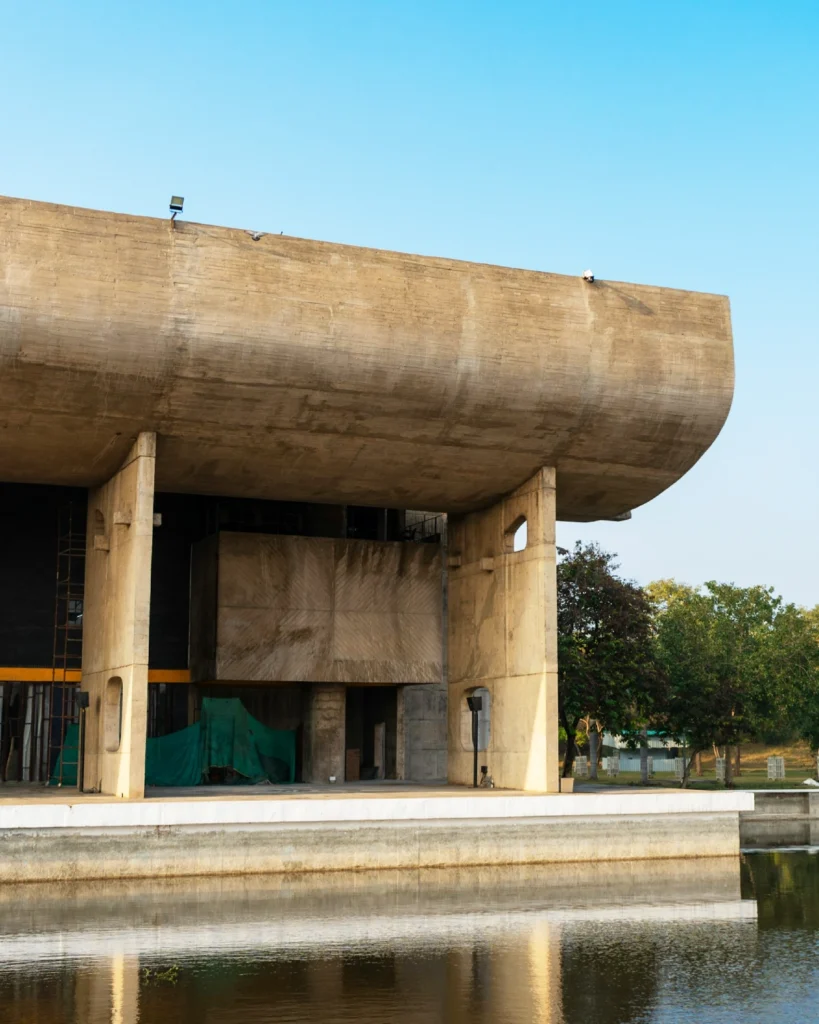
Le Corbusier’s role in shaping the city is central to its international significance. The Capitol Complex — including the Assembly, Secretariat, High Court and associated monumental spaces — forms the symbolic heart of the plan. UNESCO recognises Chandigarh’s Capitol Complex as one of the 17 components of the transnational World Heritage property The Architectural Work of Le Corbusier, describing it as the most complete contribution to Le Corbusier’s principles and his concept of the Radiant City.
One of the most interesting aspects of Chandigarh is that its architecture was never intended merely to be decorative. It was connected to ideas about society, governance, movement, public space, light, climate, and the relationship between the individual and the collective.
The Capitol Complex therefore functions almost like an architectural manifesto.
Its monumental scale communicates the importance of democratic institutions.
Its open spaces create relationships between buildings.
Its concrete surfaces, geometric forms, sun-control elements, ramps, shadows, and sculptural details demonstrate Le Corbusier’s approach to modern architecture.
The famous Open Hand became one of the city’s most recognisable symbols. Conceived as an expression of giving and receiving, it represents the idealistic spirit associated with Chandigarh’s founding.
But Chandigarh becomes much more interesting when we move beyond Le Corbusier.
The city is not a museum of modern architecture.
People live here.
They modify spaces.
They create neighbourhood identities.
They use parks, markets, institutions, streets, cafés, gardens, and public spaces in ways that inevitably go beyond the intentions of the original planners.
This creates a fascinating question:
What happens when an architectural vision meets everyday life?
That question is at the heart of understanding Chandigarh today.
Its heritage therefore lies not only in the buildings but in the continuing dialogue between design and use, vision and reality, architecture and society.
Chandigarh invites us to ask:
What was modern India trying to become in the 1950s?
And perhaps even more importantly:
What does that modernist vision mean to the people who live in the city today?
That is why Chandigarh is not simply a destination for architecture enthusiasts.
It is a place where architecture becomes a way of reading India’s modern history.